

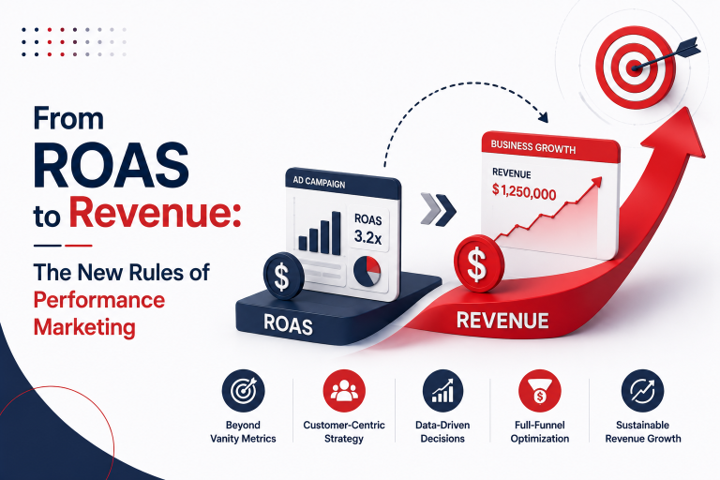
For over a decade, ROAS (return on ad spend) has been the metric that digital growth teams have leaned on to prove marketing success. Media buyers would regularly parade shiny 4x or 6x campaign dashboards, but company bank accounts told a different story. Today, high ROAS on a high platform does not mean profit for the business. Signal loss, privacy updates, and automated bidding algorithms have rendered siloed metrics unreliable. To win in modern performance marketing, we need to partner with an ROI-Driven Marketing Agency to shift to holistic business outcomes, predictable revenue, and unit economics.
Why ROAS Fails as an Executive North Star
ROAS was designed for a simpler digital ecosystem – one where direct, deterministic pixel tracking makes it easy to map an ad click directly to a checkout page. Today, treating ROAS as your primary growth indicator introduces fundamental strategic risks that can quietly undermine enterprise health.
-
The Blended Profit Margin Blindspot
ROAS measures top-line ad-attributed revenue against ad spend. It completely ignores the product cost of goods sold (COGS), shipping fees, platform transaction charges, and return rates. 5x ROAS campaign on a product with a 15% gross margin is losing money on every single order. In contrast, a 2x ROAS campaign on an ultrahigh-margin SaaS product or subscription tier could generate huge net profit. Brands are flying blind on the actual bottom-line impact if they judge campaigns solely on ad returns without factoring in gross margin.
-
Platform Cannibalization and Retargeting Traps
Ad networks like Meta, Google, and TikTok use proprietary machine learning to hit target metrics. Left unchecked, automated bidding strategies often take the path of least resistance – retargeting warm audiences, bid-sniping high-intent branded search queries, or serving ads to users who would have purchased organically anyway. The platform records a high ROAS, but the business gains zero incremental revenue.
-
Siloed Multi-Touch Attribution Inflation
With each channel claiming ownership of the same consumer, the figures reported by channels will become completely distorted. With one prospect clicking on an ad placed through Google Search, then watching an Instagram Reels video before converting through a retargeted banner ad, the three channels claim 100% ownership of that conversion’s value. The total reported revenue of the channels will exceed the company’s actual revenue.
The New Evaluation Framework – Unit Economics and Blended Metrics
To transition from ad returns to reliable top-line growth, growth leaders – often in tandem with an ROI-Driven Marketing Agency – must replace single-touch ROAS with cross-channel efficiency metrics and core unit economics.
Marketing Efficiency Ratio (MER)
Also known as “Blended ROAS,” MER looks at overall business performance rather than isolated channel claims.
MER provides an unvarnished view of business health. When overall sales rise while total media investment stays flat, your marketing program is expanding market share. If platform-reported ROAS increases while MER declines, ad platforms are simply taking credit for organic demand that was already going to happen.
Contribution Margin 3 (CM3)
Sophisticated finance and marketing teams optimize directly for post-ad contribution margin. This metric accounts for revenue after subtracting COGS, fulfillment, transaction fees, returns, and variable marketing spend. Scaling ad dollars until total contribution profit dollars max out – rather than where percentage ROAS looks prettiest – ensures every dollar spent expands net cash flow.
First-Order Profitability vs. LTV Realities
Acquiring customers at a loss while relying on long-term Customer Lifetime Value (LTV) made sense when capital was cheap, but today’s market demands strict fiscal discipline. Focusing solely on immediate acquisition costs often blinds companies to broader enterprise growth. True long-term viability requires a balanced strategy that pairs short-term performance with enduring brand equity. Relying strictly on a paid media agency without a clear grasp of actual payback windows creates a fragile, unsustainable growth model.
Strategic Shift – Building a Revenue-Engine Architecture
Moving away from vanity metrics requires restructuring how acquisition campaigns are built, measured, and scaled. High-growth organizations focus on three core pillars to turn paid media spend into scalable revenue.
| Modern Revenue Pillar | Strategic Execution | Core Business Outcome |
| 1. First-Party Data Pipeline | Implement CAPI, server-side tracking, and CRM sales data passback. | Feeds real profit signals directly into ad network algorithms. |
| 2. Data-Informed Allocation | Utilize geo-lift holdout tests and Media Mix Modeling (MMM). | Identifies true incremental revenue lift across channels. |
| 3. Business Outcome Bidding | Deploy value-based bidding (VBO) and margin-weighted product feeds. | Optimizes spend for high-margin buyers and long-term customer value. |
-
Feed Real Profit Data to Ad Algorithms
Ad platform machine learning is only as smart as the data fed into it. If platforms are optimized purely for top-line revenue signals, they will optimize high top-line revenue – even if those sales come from low-margin inventory or high-return customer segments.
Leading teams utilize server-side tracking, conversions API setups, and offline conversion imports to pass profit-adjusted values back to Google and Meta. By telling ad algorithms the actual gross margin or predicted LTV of a conversion, auto-bidding algorithms actively seek out profitable, high-value buyers. Aligning ad networks with broader frameworks like an AI powered performance marketing architecture ensures campaign automation drives bottom-line profitability rather than platform activity.
-
Validate Growth with Incrementality Testing
To know if media spend truly drives business expansion, implement regular incrementality testing. By running geo-lift tests or structured holdout experiments – where a matched control group is intentionally suppressed from seeing ads – growth managers determine true conversion lift.
For instance, a growth team might pause paid search or retargeting campaigns in designated test regions while keeping them active in control markets. If top-line revenue remains identical across both regions, the paused media spend was non-incremental and can be immediately reallocated into upper-funnel customer acquisition.
-
Diversify Paid Media Placement
Relying entirely on a single paid channel leaves brands vulnerable to platform volatility, rising cost-per-mile (CPM) rates, and sudden algorithm updates. A balanced acquisition engine pairs intent-based capture with visual discovery formats.
Navigating channel allocation, budget splits, and audience overlap across platforms requires evaluating creative formats and intent levels through a structured breakdown of Meta ads vs Google ads to ensure paid search and paid social reinforce each other effectively rather than competing for the same conversion.
Tactical Execution Roadmap for Growth Teams
Transitioning an organization from ROAS-chasing to revenue optimization requires aligning incentives across marketing, finance, and product teams through a phased approach.
Phase 1- Metric Realignment
- Establish MER and Contribution Margin 3 (CM3) as core C-suite dashboards.
- Shift internal KPIs from platform ROAS to net contribution profit generated from paid advertising services.
- Audit existing retargeting and branded search spend for incrementality.
Phase 2- Technical Infrastructure
- Implement Server-Side Conversions API (CAPI) across all active channels.
- Integrate CRM & ERP margin data with ad feeds.
- Set up dynamic conversion value passback to reflect net margin per SKU.
Phase 3- Creative & Campaign Optimization
- Structure ad account feeds around margin buckets rather than generic product categories.
- Shift creative focus toward high-LTV product tiers and high-margin offers.
- Run quarterly geo-lift holdout tests to adjust channel budget distribution.
Operationalizing Sustainable Growth
Executing this transition requires deep technical expertise across tracking infrastructure, media allocation, and financial analytics. Brands that successfully bridge the gap between media buying execution and CFO-level financial modeling often collaborate with a specialized performance marketing agency to build robust attribution frameworks.
Choosing a seasoned growth partner over unverified platform dashboards ensures budget allocation is driven by incrementality and actual contribution profit. Advanced tracking architectures prevent channel cannibalization, while linking media strategies to enterprise unit economics makes paid acquisition a predictable engine of sustainable enterprise growth.
Concluding Thoughts
The age of relying on inflated platform ROAS as proof of marketing success is officially over. As acquisition landscapes grow more competitive and privacy updates alter signal visibility, sustainable growth belongs to brands that measure what truly matters.
By partnering with an ROI-Driven marketing agency to focus on marketing efficiency ratio, contribution margin, and true incremental lift, growth leaders can break free from platform vanity metrics. Aligning ad channels with enterprise unit economics turns marketing from a cost center chasing ad returns into a predictable, profit-generating driver of long-term value.
